
A new take on Batman’s story points to the power of a greater one.
 Even as Christopher Nolan’s version of the Dark Knight’s legend ends onscreen, another version takes wing on the comics page. The second entry in DC Comics’ series of Earth One original graphic novels, Geoff Johns and Gray Frank’s Batman presents a solid and entertaining retelling of the Caped Crusader’s origin, successfully (and wisely) taking cues from both Nolan’s “real world” approach and more colorful elements of the character’s past.
Alfred Unleashed
Johns keeps Batman’s origin story and much of Batman’s world familiar, at least in rough outline. Bruce Wayne is still the orphaned rich boy who first dons his fear-inspiring cowl and cape to avenge his parents’ murder. Gotham City is still crime-ridden and corrupt—all the more so because, in this telling, one Oswald Cobblepot is mayor. (Since you’re reading this blog, you probably recognize that name; on the off chance you don’t, trust me: you’ll recognize him when you see him.) Jim Gordon is a beleaguered police detective (not yet commissioner) with a bookish, redheaded daughter named Barbara, caught between his duty as a cop and his responsibility as a father. Lucius Fox is younger than we’ve seen him before, but he’s still the technical whiz behind Batman’s “wonderful toys” (Jack Nicholson’s memorable phrase—but no Joker, whether like Nicholson, Romero, or Ledger, appears).
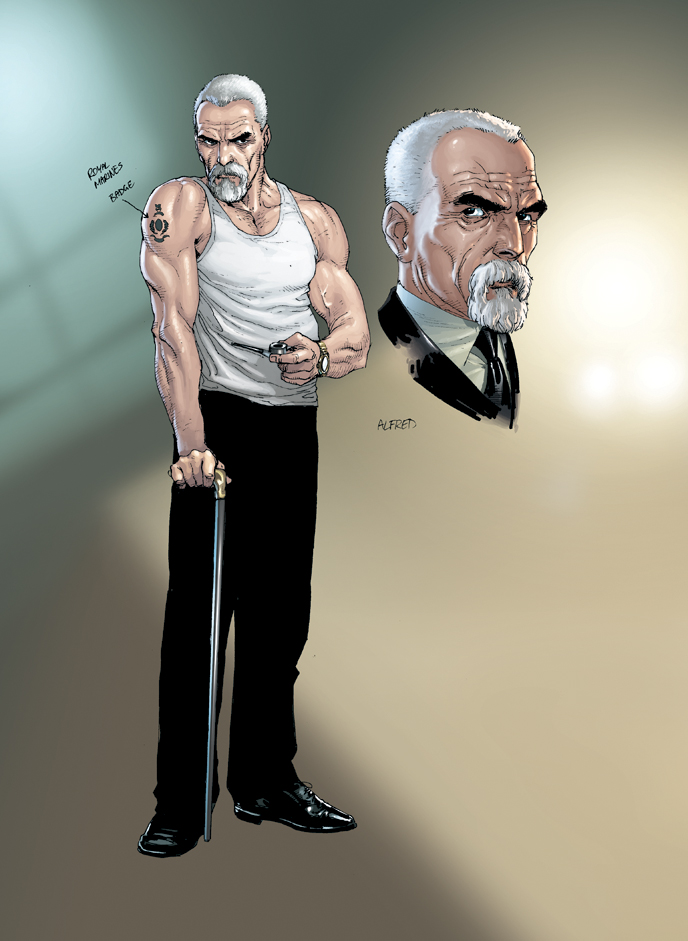 The most notable point of departure occurs when we meet Alfred. He’s still British, but now he’s an ex-Royal Marine with a prosthetic leg and a cane. Neither Michael Gough’s gentle manservant nor Michael Caine’s tender-hearted father-figure, this Alfred is tough and grizzled, scarred physically and emotionally by what he’s seen and done in battle. He saw combat with Thomas Wayne, and—unbeknownst to Alfred—Wayne named him Bruce’s legal guardian in the event of the unthinkable.
The book passes over most of Bruce’s childhood; as with Jesus in the gospels, we catch only a glimpse here and there, enough to get the sense that Alfred and his ward aren’t particularly close. We do know, however, that Alfred disapproves of Bruce’s vigilante quest for vengeance: “So this is your life now?… The kind of people you’re hunting don’t get scared… I didn’t teach you how to fight so you could go on some insane crusade.” He also insists that, “to do this properly,” Bruce needs a gun. True to previous incarnations, Bruce refuses to use one—but the book’s falling action suggests not even Batman can escape the consequences of that decision.
Bruised-and-Battered Man
The whole book, in fact, shows Batman failing as much as succeeding. Some of his victories are narrowly won. The first ten pages, for instance, masterfully upend readers’ expectations. Frank’s art reaches almost cinematic quality as it depicts, with virtually no dialogue, a hot pursuit gone wrong. The sight of Batman crashing to the ground into garbage cans is undeniably amusing (perhaps a split-second evocation of Adam West’s aura?); seeing Batman turn away from a just-robbed shop owner on the next page is positively heartbreaking.
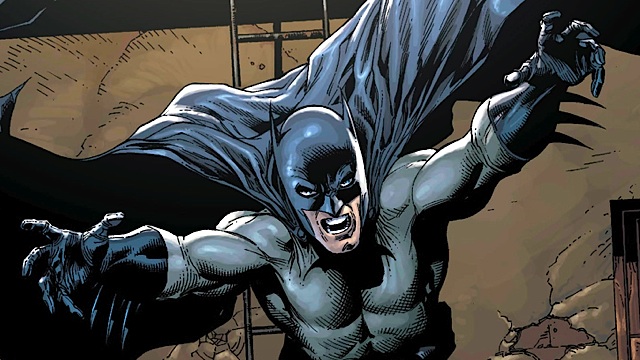 Of course, it’s no spoiler to tell you that Earth One: Batman is not, in the end, any radical deconstruction of the hero. It doesn’t show him struggle simply for the sake of reveling in revisionism—a temptation to which I feared the book might succumb. Although I’m not a die-hard Batman fan, I appreciate that his ability to prevail against great odds without superpowers (ostensibly—his wealth is his superpower; Alfred even acknowledges, early on, that the family fortune means Bruce will never know a normal life) is a large part of his appeal. I didn’t want a Batman story where the man beneath the mask is “only human.” Even if he can’t fly faster than a speeding bullet, Batman’s no average Joe. His exceptional skill, discipline, and dedication make him a hero who deserves the “super-” prefix.
Story and Salvation
Again, however, Earth One: Batman is just the beginning of this version of the legend. It acknowledges Bruce Wayne’s potential, but also questions how effective he can be on his own. One of the story’s prominent themes is the importance of helping and accepting help from others. This theme surfaces most clearly in Bruce and Alfred’s story, but also in Gordon’s relationships: with his unwanted new partner, Harvey Bullock (in this rendition, Bullock begins as a pretty boy cop who transfers to Gotham from a posh, televised Hollywood beat in order to take a PR-motivated crack at solving the Waynes’ murder); and with Barbara, who reminds him—as, in the wake of Mrs. Gordon’s death (I think Gordon as a single father is a new element; long-time Batfans, correct me if I am wrong), to make their rent and pay their utilities—“We’re in this together.” There’s even a gorgeous page with a tantalizing hint of a familiar Batman ally on the horizon.
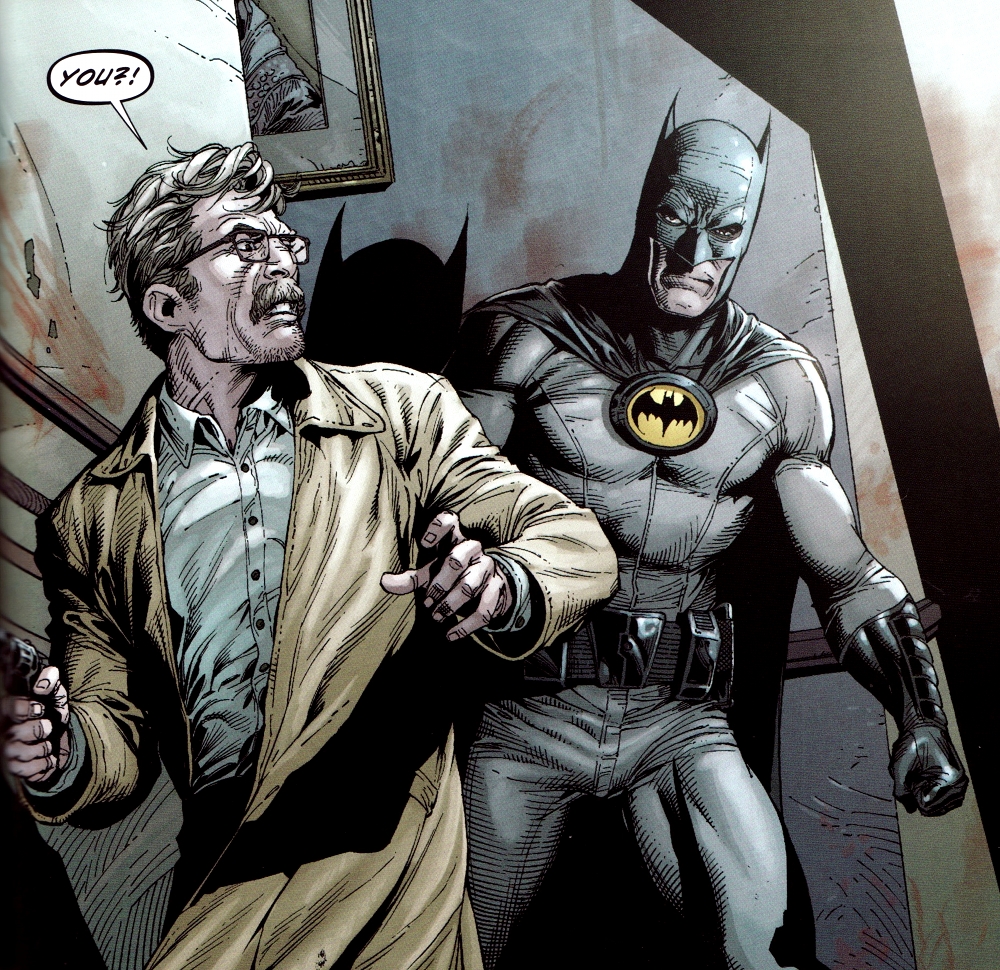 But the book also states Bruce will need a non-human ally in order to fulfill his quest. (No, not Superman.) In one of four splash pages at the conclusion, Alfred declares, “We need to build a legend.” The moment is clumsily handled, but the truth supporting it is sound. Batman is more than one crime-fighter. He is an idea and an ideal (as Batman Begins so beautifully argued). If you’re among that “superstitious and cowardly lot” he’s after, Batman is a persistent urban myth you can’t shake no matter how hard you try (as in the opening sequence of the 2008 animated DVD Batman: Gotham Knights). If you’re a law-abiding citizen, and even more so if you’re one of the people an affluent and powerful society oppresses, victimizes, and pushes to the margins, he is a nearly Arthurian myth of justice done, of might used in the service of right, of safety and salvation.
Quest for the Historical Batman?
Batman is a narrative that generates meaning. In Earth One: Batman, we see the strata of that narrative exposed; we get an examination of its foundations. As a result, the book, even after repeated readings, feels a bit shaky and rough. Familiar pieces are there–Arkham Asylum; Harvey Dent; even a prototype of the weird theme villains who populate Batman’s world–but, even discounting Johns’ “tweaks,” they don’t quite always hang together. But perhaps that’s by design. Perhaps we’re being invited to consider a “quest for the historical Batman.”
As with the historical quest for another salvific figure with whom Sci-Fi Christians are (hopefully) even better acquainted than Batman, it’s not the bare facts but the story in which they play their part that matters most.
Please don’t misunderstand me. Yes, Christianity is a religion that rests on particulars. “The Word became flesh and lived among us” (John 1.14)—in a particular time, in a particular place. As one of my denomination’s statements of faith reminds us, “Jesus, a Palestinian Jew, lived among his own people and shared their needs, temptations, joys, and sorrows” (The Confession of 1967, 9.08). As the Apostles’ Creed unashamedly affirms, he was “born of the Virgin Mary” and “suffered under Pontius Pilate.” Jesus of Nazareth left a historical footprint. No credible scholar holds he simply didn’t exist.
But it’s not the historical existence of Jesus that saves. And, while I do believe God raised Jesus from death hat first Easter morning, even if we could locate his tomb with one hundred percent certainty and prove, empirically and scientifically, that it was empty, and even if we could somehow prove that the cause was a miraculous overthrow of mortality, not even those historical facts would assure us of salvation.
The historical data about Jesus matter because, as Luke explained when writing his gospel, they are pieces that must be interpreted—or, perhaps more accurately, appropriated: the evangelist “decided, after investigating everything carefully from the very first, to write an orderly account for you… so that you may know the truth concerning the things about which you have been instructed” (Luke 1.3-4). If faith were merely a matter of proving facts, everyone would believe in Jesus as Lord and Savior. Instead, the facts have to be told in context, as elements of the story of God’s saving purpose. They are, to borrow Earth One: Batman’s terms, the building blocks of “legend.” And this “legend” that is more than legend, this myth—not in the sense of falsehood or fantasy, but in the sense of a narrative that gives and sustains meaning—is where we encounter the risen Jesus, the living Word, even today. That’s why, as the old hymn has it, we “love to tell the story”—or should! After all, as the apostle Paul asks the Romans, “How are they to call on one in whom they have not believed? And how are they to believe in one of whom they have never heard? And how are they to hear without someone to proclaim him?” (Rom. 10.14). We’ve got to tell the story, because—as with the story, the legend, of the Batman—the story can change the world.
No; even more so. The story’s author—who is also the Author of Life (Acts 3.15)—changes it. And us.
Scripture quotations are from the New Revised Standard Version.


This sounds awesome, Michael! Is this in anyway related to The New 52? If it is, I probably won’t check it out…but it sounds like my kind of story. Great article!
Hey, Max – It’s not part of The New 52, no. It’s an “Elseworlds” in all but name, I think; although the “Earth One” brand makes me think DC might be planning it as its own self-consistent alternative continuity (as much as any comics continuity can be, anyway!)
Oh, maybe like Marvel’s Ultimate universe? Isn’t there another Earth one book? Superman, perhaps?
I enjoyed Superman Earth One FAR more than Batman Earth One. The highlight of Batman Earth One was the art, for me. And as a comic book writer, it’s usually the writing that stands out for me. Plus, Geoff Johns is such a good writer than he made it so I no longer have to be embarrassed about liking Aquaman! Yet, teh story fell flat for me. For all the talk of this being a new, unique take on Batman’s origin, we’ve seen this all before. Yes, minor details were changed (instead of Joker or Rha’s Al Ghul causing his parent’s death, it’s yet ANOTHER bad guy worked into the origin), but that just wasn’t enough for me. It’s solid, but it’s not new. After Superman Earth One and Geoff Johns other work, I felt let down.
Interesting take, Ben – thanks for sharing it. My initial reaction was that Batman struck me as the better of the two books, but after two further readings my enthusiasm for it dimmed a little. Still, I’m not sure either of the Earth One books are really innovative when it comes to these characters and their worlds. If anything, I’d give the nod to Batman solely on the strength of the reimagined Alfred. Also, I think that the stuff about the Arkham legacy may be a new element in the Batman mythos? (Not sure – better Bat-fans than I will have to let me know.) All in all, I still walked away from Batman feeling I’d like to read more, whereas with Superman — eh. Maybe. (And he’s my favorite of the two characters!)
The Arkham stuff really bugged me. First of all, it was never really explored — too much STUFF was packed into this book to really let any of it breath. Splash pages felt like wasted space in some ways, because it meant lost space for story that had to get pushed away. Second, why does EVERYTHING have to be linked? It’s like it’s set in the Lost universe or something!
Good points both, Ben. The first draft of my review actually had a complaint about the number of splash pages in a fairly thin and getting-kind-of-pricey book. (It is a tactile pleasure, though, with those sturdy boards and textured spine… oops, sorry, my day job working with books showing!) I wondered if maybe this had begun life as a “Secret Origin” miniseries that had to get truncated some to fit into the “Earth One” format. I hope a future volume will breathe easier.
No, not everything must be linked; but, as in the new “Amazing Spider-Man” movie, I kind of thought it was cool that so much did. Perhaps it speaks to our need for order and meaning in a (seemingly? actual?) chaotic universe.
I have put in my request at the library! You sold me at Batman.
Wait, I should be embarrassed for likely Aquaman! That can’t be right!
Daniel, have you read the Elseworlds book “Superman: Speeding Bullets”? I just learned of it today – the premise is that Kal-El crash lands in Gotham and is adopted by Thomas and Martha Wayne, who are then murdered… essentially, Clark becomes a superhero with Superman’s powers and Batman’s motivation. I am going to try and get a copy… sounds intriguing!
If you want an interesting Elseworlds read, look for the “Real Worlds” series they did about ten years ago. There were four of them, and each of them explored the concept of a superhero in a world like our own: no super powers, but with these archetypes existing as they do in our world. Great take on teh characters, if my memory from ten years ago serves…
Oh, thanks for the recommendation, Ben – I’ll have to check those out.
My favorite “Elseworlds” is probably the Superman/War of the Worlds mashup from 2000 or so, which takes great advantage of the fact that Superman debuted in the same year as Orson Welles’ “Martian panic” broadcast!
Boooooo, the library does not have Speeding Bullets! You had me at Wayne!